Your emails shouldn't die in spam, MailStrike gets you into the inbox.
MailStrike is an AI-powered email deliverability platform: the most effective warming service on the market, seed lists that lift deliverability for B2C senders, and in-depth placement tests so every sender knows exactly where their campaigns go.
Prefer to talk? Book a call: see where your mail goes, with a mailbox connected live.

Your email is mostly invisible.
You pay for domains, inboxes, lists, copy, and SDRs, and your tools report sent, not filtered. You are paying for emails prospects never see.
AI-powered warming that providers trust.
An AI Agent on every mailbox builds the reputation filters trust. Templated warmup gets caught now. Agentic warmup keeps working.
Your email is mostly invisible.
You pay for domains, inboxes, lists, copy, and SDRs, and your tools report sent, not filtered. You are paying for emails prospects never see.
AI-powered warming that providers trust.
An AI Agent on every mailbox builds the reputation filters trust. Templated warmup gets caught now. Agentic warmup keeps working.
Trusted by teams at

 Stardesk
 PostNitro
 GearUp
 BetterContact
 Nimbata
 Octopus CRM
 Regie.ai
 Breakcold
 Closely
 Evaboot
 Aimfox
 Dripify
How MailStrike works.
Your mailbox joins a network of real businesses.
The MailStrike network is real companies with healthy reputations exchanging real threads. Every reply, read, and rescue is a positive signal Google and Microsoft record against your domain, from senders they already trust.
- Real inboxes on Gmail, Outlook, and Microsoft 365
- MailStrike decides who is in: no spammers, no free-mail
- Same-domain mailboxes never paired
An AI Agent on every mailbox.
Each mailbox gets an AI Agent that writes and replies the way you would, and its persona sets its own reply rate, dwell time, and hours. To Gmail and Outlook it is a person corresponding.
- Its own reply rate, dwell time, and active hours
- A typo now and then, like a person
- Never overnight
Written at send time, about your business.
Every warming email is generated by the LLM from your industry and company description, so no two are alike and there is nothing for a filter to fingerprint.
- Threads about your industry, in your voice
- Real replies, not templates
- Nothing to fingerprint
 PostNitroCase study
Half their mail to Google was in spam. They had no idea.
One Free Deliverability Test found it. Eleven days of warming took PostNitro from 67% to 100% inbox placement at Google, and it has held since. Read the case study →
Half the Google audience they were paying to reach never saw them. Found by a free test, fixed in 11 days.
Plug in a mailbox.
MailStrike does the rest.
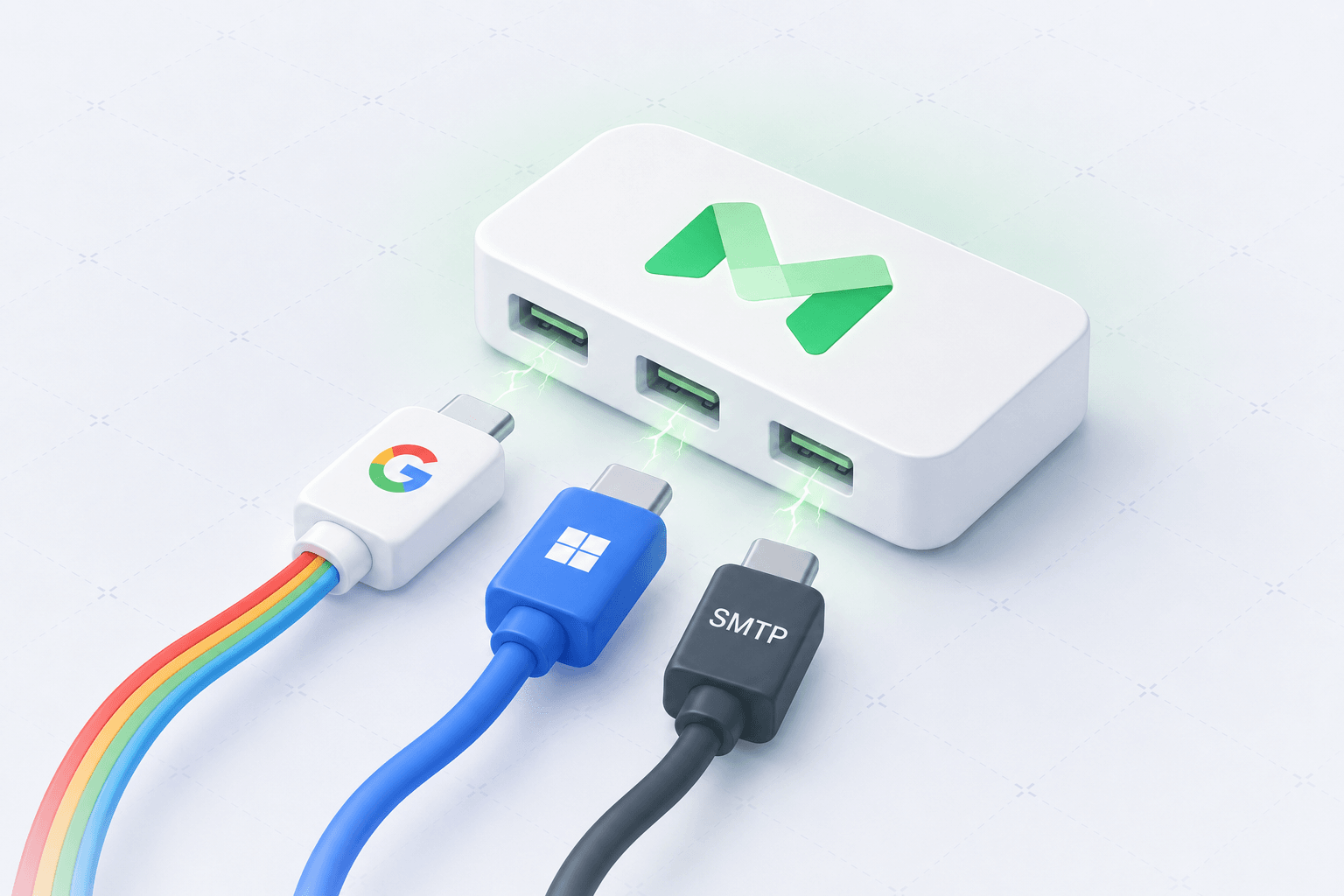
Two minutes to connect. Nothing to install, nothing changes in the tools you send from.
- 01
Connect a mailbox
One click for Google Workspace or Microsoft 365 through OAuth. MailStrike never sees your password. Anything else connects with an app password.
- 02
Pass the auth check
SPF, DKIM, DMARC, and MX are checked on connect. A missing record comes back with the exact value to publish.
- 03
Set volume and ramp
Daily volume, ramp, timezone, and the agent's persona are your settings. The defaults suit most teams.
- 04
Warming starts
Your AI Agent starts exchanging mail with the MailStrike network the same day. Warming mail is labeled and archived on arrival, so your inbox stays clean.
- Under two minutes per mailbox.Connection guides →
Google and Microsoft built filters to catch warmup. AI Agents have no pattern to catch.
Templated warmup is the pattern those filters were trained on. An AI Agent has none of it: your style, your business, content written at send time, sent in your hours.
Built for anyone who pays for email
and expects it to land.
Google and Microsoft filter new domains with no reputation, so you cannot send at scale for months. MailStrike builds that reputation in 21 days.
New-domain warmupWarm every sending mailbox so the list and sequences go out with an engagement record behind them. The dashboard says how much each can safely send.
How warming worksEvery send from a flagged domain is paid for and read by almost no one. Rebuild the record in three to six weeks, sending while it recovers.
Getting out of spamA burned domain is its inboxes and its warm list written off. Each new domain gets its own 21 days and AI Agents while the primary stays protected.
Agentic warmupA slide caught late is weeks of sends to a shrinking audience. Maintenance warming never stops, and Flashman flags the slide the day it starts.
Reputation preservationThat is where half your list stops seeing you, on a list you paid for in full. Seed lists show where a campaign lands and pull it out while the send is live.
Seed listsWe safely scaled sending volume 3 times in under 60 days. Inbox rates stayed above 90% the entire time. MailStrike actually moved the needle for us.
Three times the outbound from the same domains in under 60 days, placement holding throughout. No new domains bought.
Works with the stack you have. Warm the domain, send from anywhere.
Instantly, Smartlead, Apollo, lemlist, HubSpot and your ESP are paid for whether the mail lands or not. Warming is the part that decides whether it does.
 Gmail
Gmail Outlook
 Microsoft 365
 Zoho Mail
 Amazon SES
 SendGrid
 Mailgun
 Postmark
 Resend
 Mailchimp
 Brevo
Brevo Klaviyo
 Customer.io
 HubSpot
 Pipedrive
 Close
Close
 Instantly
 lemlist
 Smartlead
 Apollo
 Reply.io
 Woodpecker
 Mailshake
 QuickMail
 Saleshandy
 EmailBison
 Expandi
 HeyReach
 La Growth Machine
 Clay
Clay Any SMTP
Questions that come up most.
How warming works, what setup involves, and what to expect from the first three weeks.
Agentic warmup gives each mailbox an AI Agent that mimics the mailbox owner's communication style in human-like exchanges with other mailboxes in the MailStrike network, with every message generated by an LLM from the company's description and industry. Each agent has a persona, human traits such as its own reply rate, dwell time, and chance of a typo, and it keeps the owner's sending hours. The result looks like real people corresponding, not the uniform pattern of templated warmup that Google and Microsoft detect.
An AI Agent per mailbox instead of uniform pings, so the engagement looks like real people. LLM-written, multi-turn threads instead of canned templates, so there is no content for filters to flag. And a controlled network: MailStrike decides who is in the MailStrike network, so no spammers, free-mail senders, or dodgy sites can damage your reputation from inside it. Warming mail that lands in spam is also rescued and marked important, a correction opens-only tools cannot make.
Yes, when the engagement is realistic and the network is clean. Providers score senders on engagement history, and warming builds that history by having real mailboxes open, read, and reply to your mail. Where it fails is templated, pooled warmup: Google and Microsoft now run filters trained on that pattern, so it can flag a domain instead of helping it. MailStrike's AI Agents produce the varied, human-like engagement those filters trust. PostNitro went from 67% to 100% inbox placement at Google in 11 days.
Warming through a controlled network produces the same signals as organic engagement, so it is safe for your domain. Google's sender guidelines do not mention warming services. They ask senders to start with low volume to engaged recipients and increase gradually, which is exactly the curve MailStrike automates, within the daily limits you set. Same-domain mailboxes are never paired, provider rate limits are respected, and warming mail only ever goes to mailboxes in the MailStrike network, never to your real prospects. Authentication still has to be in place first, and warming never replaces a clean list.
Flashman is MailStrike's AI assistant. Every day it reads the data for every connected mailbox and writes a short deliverability summary: unusual trends across your inboxes, what to do about them, and outbound recommendations based on inbox health, such as how much to send today, whether open-rate tracking is safe to leave on, and what send delays to use. You do not need to watch every graph for every mailbox. Flashman tells you what matters.
Seed lists are for B2C senders reaching consumer inboxes at Gmail and Outlook. You export a batch of seed addresses as a CSV into whatever tool sends the campaign, mixed into a real send to protect it or sent first to build good signals on the content and domain. The seeds open the email, rescue it from spam, read it for a varied length of time, and a small share mark it important. Seed lists are a standalone product priced by seed volume.
Yes. Sender reputation decays without ongoing engagement signals, and inbox providers re-evaluate senders continuously. After the ramp, MailStrike drops to a maintenance volume of about 15 to 25 warming emails a day per mailbox and keeps going in the background, so the reputation curve stays flat or rising while real campaigns go out. Flashman summarizes every mailbox daily and flags a slide before it costs you placement.
Google Workspace and Microsoft 365 connect with one-click OAuth. Yahoo, Proton, iCloud, Zoho, Fastmail, and any other provider that exposes IMAP and SMTP connect with an app password. Campaigns you send through Amazon SES, SendGrid, Mailchimp, Brevo, or a sequencer benefit too: MailStrike warms the domain, and you keep sending from whatever platform you already use.
Google Workspace and Microsoft 365 connect with one-click OAuth, so MailStrike never sees your password and access can be revoked from your Google or Microsoft account at any time. Any other provider connects with an app password over IMAP and SMTP. Either way it takes under two minutes per mailbox, and MailStrike runs an SPF, DKIM, DMARC, and MX check the moment the connection lands.
Yes. Authentication is the entry ticket and warming builds reputation on top of it. MailStrike checks all three records, plus MX, automatically when you connect and flags anything missing with the exact record to publish. The free Email Auth Checker runs the same audit for any domain without an account.
No. Inbox visibility is set to Hidden by default: warming mail is labeled and archived the moment it arrives, so your real inbox stays clean and your team never sees a warming thread. You can change that in Settings. Warming is scoped to those threads through an OAuth grant you approve and can revoke.
Yes, and you should. Warming runs alongside live sending at a daily volume you control, so there is no pause in outreach. On a brand-new domain, let the 21-day ramp finish before the first campaign; the dashboard tells you when a mailbox is safe to send from. Then start at 20 to 30 sends a day per mailbox and scale while warming continues in the background.
Yes. Pricing is per mailbox up to 200 on the pricing page, and larger sets are on the Custom plan, with API access. Every mailbox gets its own AI Agent, so a multi-mailbox domain looks like a team of real people rather than one script repeated. Connecting at least three mailboxes, each agent on a different persona, is the recommended setup.
By around the two-week mark you should see a noticeable improvement in deliverability, and a standard ramp reaches full volume by day 21 on a clean account. The exact curve depends on what is happening outside MailStrike: bounce spikes from a bad list, spam complaints, sudden volume jumps, or domain changes all slow it down. A domain that is already in spam usually takes three to six weeks.
21 days on a standard ramp. The dashboard tells you when the mailbox is safe to send from and how much it can send today. Start at 20 to 30 sends a day per mailbox and scale while warming continues in the background.
Yes, that is one of its main use cases. Agent engagement combined with active spam rescue, where mailboxes in the MailStrike network pull your mail out of the spam folder, mark it important, and engage with it, rebuilds the reputation step by step. Damaged domains take longer than fresh ones, usually three to six weeks depending on the history, but PostNitro went from 67% to 100% inbox placement at Google in 11 days.
Warming is priced per mailbox, and the rate falls as you add more, billed monthly or annually with a lower rate on annual. Each mailbox includes one deliverability test a month. Above 200 mailboxes the Custom plan is quoted. Seed Lists are a standalone product priced by seed volume. Current prices are on the pricing page.
Yes, through a call. MailStrike does not offer a self-serve trial, because letting anyone sign up is what fills a warming network with the senders you do not want your reputation mixed with. Other tools allow it, and their real customers pay for it in results. Book a call and the trial starts with one of your mailboxes connected on the spot. If you only want to see where your mail lands today, the Free Deliverability Test needs a signup but no call and no card.
More than the tool spend. The domains, the inbox seats, the list, the copy and the reps are paid for in full whether the mail arrives or not, and a sequencer reports sent, not filtered, so the share that lands in spam is invisible in the tool that sent it. The quickest way to see your own number is a Free Deliverability Test: it reports inbox, promotions or spam per provider for a real send.
Run the Free Deliverability Test and look at the placement it reports. If a meaningful share of your mail is landing in spam or promotions, book a call and trial MailStrike on your own mailbox before you commit to anything. If it is already landing, the reputation preservation use case explains what keeps it there.